Reviewed · TOURS IN DUBAI
Dubai: Cultural Lunch at The Sheikh Mohammed Center
Dubai’s big attractions show you wealth, speed, and polished modern design. This 1.5-hour cultural lunch shows you something quieter: how Emirati customs, Islam, hospitality, and daily life fit together. You eat in a traditional wind tower house in Al Fahidi, with time to ask direct questions rather than simply watch a performance.
I like the relaxed setting on floor cushions and the chance to talk openly with a host. I also like the useful mix of Arabic coffee, dates, tea, and local dishes, since food gives the conversation a natural starting point. The main drawback is finding House 26, especially when construction or poor signage makes Al Fahidi’s lanes confusing.
Key points
- A meal with a purpose: The food is served as part of a conversation about Emirati life, customs, and Islam.
- Traditional setting: You eat in a wind tower house in the Al Bastakiya trading village, within the Al Fahidi Historic District.
- Open questions welcome: The center encourages frank discussion about local values and sensitivities.
- English-speaking hosts: Hosts such as Khaled, Nasser, Ruqaya, and Moeen Murad have led sessions.
- Good first-day choice: The relaxed format helps you understand Dubai before visiting mosques, museums, or older neighborhoods.
- Allow time to find it: The meeting point is House 26 on Al Musallah Road, beside the Ruler’s Court.
Why this lunch adds something Dubai’s skyline cannot
Dubai can make Emirati culture easy to miss. You see grand hotels, shopping centers, highways, and a large international population. The local customs are there, but they do not always explain themselves.
At the Sheikh Mohammed Center for Cultural Understanding, the meal becomes a doorway into that explanation. You sit down, eat, and ask what you actually want to know. That might be about greetings, clothing, marriage, religion, family expectations, hospitality, or the meaning behind a custom that seems unfamiliar.
The center’s motto is Open Doors, Open Mind, and the format supports it. This is not a lecture where you sit quietly while someone races through dates and facts. Your questions help shape the session, so two lunches can feel different depending on the interests around the table.
I would especially consider this experience early in a Dubai stay. A little context about Islam and Emirati values can change how you read the city afterward. You may notice the importance of hospitality, prayer, modesty, family, and respect in places that first seemed purely modern.
Other trips people book in Dubai:
- Dubai: Burj Khalifa Levels 124 & 125 Entry Ticket + Options
★ 4.3 · 90,891 reviews - Dubai: Desert Safari, Quad Bike, Camel Ride & Al Khayma Camp
★ 4.9 · 68,962 reviews - Dubai: Desert Safari, Quad Bike, Camel Ride and Sandboarding
★ 4.9 · 43,505 reviews
Entering House 26 in Al Fahidi
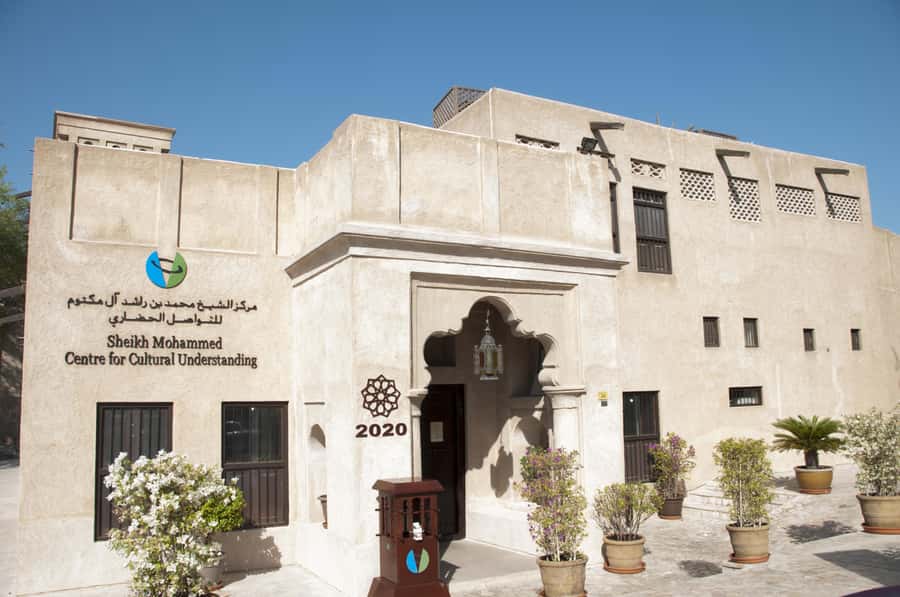
The meeting point is House 26, Al Musallah Road, in the Al Fahidi Historic District, next to the Ruler’s Court. The building sits in the old Al Bastakiya trading village, an area known for traditional courtyard homes and wind towers.
The setting matters. A wind tower is not just decoration for a heritage district. It reflects older ways of dealing with Dubai’s heat before air-conditioning. The narrow lanes, shaded courtyards, and thick-walled homes give you a useful contrast with the glass towers elsewhere in the emirate.
Give yourself extra time to find the correct entrance. Al Fahidi can be hard to read, and construction has sometimes blocked streets and paths. A welcome sign at the wrong door can add to the confusion. I would arrive early, keep House 26 and Al Musallah Road in front of you, and ask locally if you are unsure.
This is one of those small practical details that can affect the whole experience. Arriving flustered and late is a poor start for a meal built around relaxed conversation.
Settling onto cushions for the meal
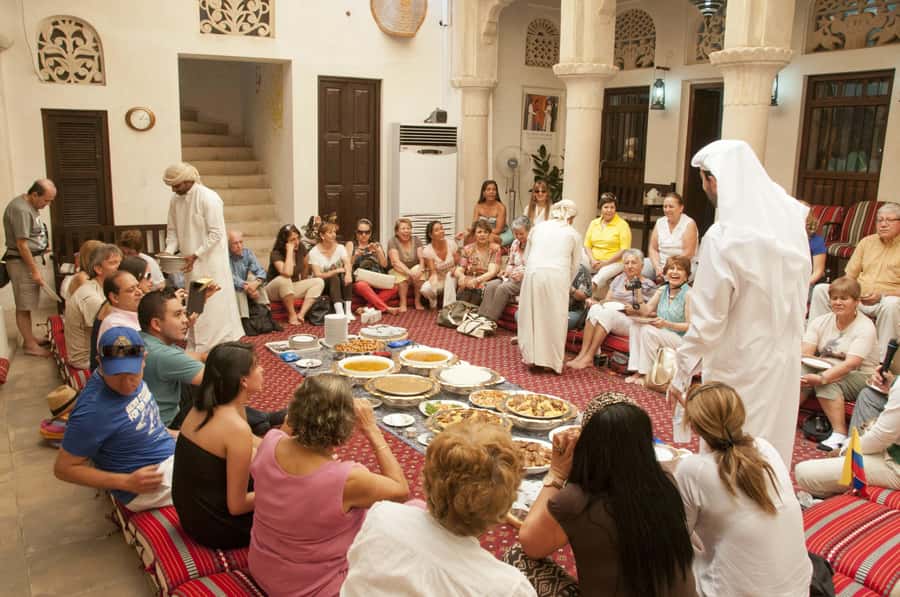
The lunch takes place in the center’s courtyard, where you sit on traditional floor cushions. If you are used to restaurant chairs, the arrangement feels different, but it suits the experience. You are sharing food and conversation in a setting that feels closer to a home courtyard than a formal dining room.
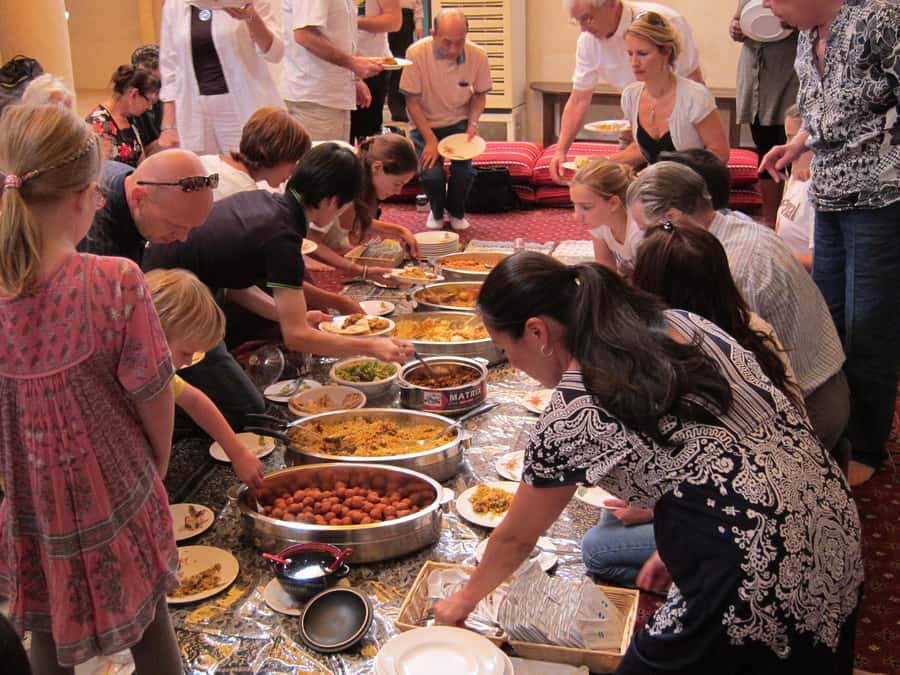
The meal includes a selection of local Emirati dishes, along with Arabic coffee, tea, dates, and dessert. The food is not treated as a side note. It gives your host a way to explain hospitality and local habits while you taste what is being served.
Do not expect a standardized restaurant menu with a printed list of every dish. The supplied details do not name the individual foods, and the selection can vary. One past account found the meal more Indian in character than expected, rather than strictly Arabic. That is worth keeping in mind if you are booking specifically to sample a particular Emirati recipe.
Still, the overall food experience is consistently central to the appeal. The meal is described as delicious, traditional, and well prepared, with especially warm comments about the food and hospitality. You may also be able to take leftovers away, though the containers used have included foil and plastic bags. If that matters to you, bringing a reusable container is a sensible choice.
Asking the questions you might normally avoid
The strongest part of the lunch is the question period. You are not limited to safe subjects such as food or architecture. The center is designed to explain local culture and clear up misunderstandings between people from different backgrounds.
A good host can explain not only what Emiratis do, but why certain customs matter. That distinction is important. A list of rules is easy to forget. A story about respect, family, faith, or social behavior gives the rule a place in ordinary life.
Past hosts have included Khaled, Nasser, Ruqaya, and Moeen Murad. The individual style will vary, but the format depends on an engaging English-speaking host who can handle a wide range of questions. Nasser was praised for his humor, while Ruqaya was described as especially clear in explaining Emirati culture. Khaled has also been singled out for making the session welcoming and informative.
You should come with a few questions of your own. Ask about the role of Islam in daily life, how Arabic greetings work, what hospitality means, or how local traditions have changed. You can also ask about topics that feel sensitive in a normal sightseeing setting. The center’s purpose is to make that conversation easier and more respectful.
The quality of the session will partly depend on the host and the questions asked around you. That is not a flaw so much as the nature of the format. You are joining a real conversation, not receiving a fixed audio guide.
Same base, a different sort of day:
- Dubai: Safari, Quad Bike, Camel Ride, and Buffet Dinner
★ 4.9 · 33,424 reviews - Dubai: Red Dune Safari, Quad Bike, Camel Ride, BBQ Dinner
★ 4.9 · 32,185 reviews - Dubai: Premium Safari, Camel Ride & Al Khayma Camp 3-Buffets
★ 4.9 · 30,335 reviews - Dubai: Burj Khalifa Sky Level 148, 124, & 125 Entry Ticket
★ 4.6 · 23,827 reviews
What you learn about Islam and Emirati values
The lunch offers an introduction rather than a full course in religion or sociology. You will hear about the impact of Islam on local values and sensitivities, but the 1.5-hour schedule places a natural limit on how far the discussion can go.
That time is enough to correct common misunderstandings and give you a better starting point. You can learn how religion relates to hospitality, social conduct, modesty, and daily expectations. You can also ask for clarification when something you have seen in Dubai does not make sense to you.
I appreciate that the center connects religious ideas with ordinary behavior. You are not simply shown a religious object or given a list of dates. The conversation can help you understand why certain actions matter to people living in the UAE.
If you want a detailed study of Islamic theology, Emirati history, or the country’s political development, this lunch will not cover everything. It works best as an open introduction. You leave with a clearer frame for the rest of your time in Dubai and, ideally, a few subjects you want to explore on your own.
How authentic is the food and setting?
The setting is the more dependable part of the cultural experience. You are in a traditional home in an old district, seated on floor cushions, with Arabic coffee and dates served as part of the welcome. Those details create a clear connection to Emirati hospitality.
The menu deserves a more careful description. It is presented as Emirati and includes local dishes and dessert, but individual dishes are not specified. Do not book this expecting a guaranteed list of famous foods. Menus can differ, and one account found the selection more Indian than expected.
That does not make the meal a failure. Dubai’s food culture is shaped by many communities, and a less predictable menu can also lead to a useful conversation about the wider UAE. But if your main goal is a precise culinary tasting, check the current menu before booking.
For most people, the food works best as part of the whole hour and a half. You are paying for the meal, the location, and access to conversation. The value is not measured only by how many dishes arrive.
Is $42 a fair price?
At $42 per person, the lunch costs more than an ordinary meal at a casual restaurant. You should not compare it only with the price of rice, meat, coffee, or dessert.
The fee also covers a structured cultural program in a historic building, an English-speaking host, and the chance to ask questions about subjects that are difficult to understand from guidebooks. If you are interested in local culture, that makes the price reasonable, especially as an early-Dubai orientation.
The value is strongest for a first visit or for anyone who wants personal context rather than another sightseeing stop. A family, couple, or solo visitor can use the session to get practical insight into customs before exploring the city.
The value is weaker if you mainly want a quiet lunch, a guaranteed menu, or a formal tour of Al Fahidi. You can eat more cheaply elsewhere, and the activity does not promise a long walking tour through the district. Think of the meal as a conversation program that happens to include lunch, not as a restaurant reservation with a cultural label.
Who will enjoy this experience most?
I would recommend it to anyone curious about the UAE beyond its shopping malls and modern architecture. It is particularly useful for first-time visitors who want to avoid cultural guesswork.
It also suits people who enjoy asking questions. The open format rewards curiosity more than passive sightseeing. If you have wondered about Arabic greetings, Islamic customs, Emirati family life, or local ideas of hospitality, this is a direct way to start learning.
Families may find the meal easier than a long museum visit, since food and conversation keep the pace relaxed. Visitors with limited time can also fit it into a Dubai itinerary because the session lasts only 1.5 hours.
You may want to skip it if you dislike group discussion or prefer a tightly scripted tour. You may also be disappointed if you expect a full menu of named Emirati specialties or a detailed historical tour of the Al Fahidi district.
The center is wheelchair accessible, which makes the experience more practical for many people. The available language is English, and the host or greeter is also listed as English-speaking.
Booking, timing, and the small practical details
Starting times vary, so check availability for the day you want. The duration is fixed at 1.5 hours, making it easy to place before or after other plans in Al Fahidi.
You can cancel up to 24 hours in advance for a full refund. The reserve-now, pay-later option also lets you hold a place without paying at the time of booking, which is helpful when your Dubai schedule is still shifting.
No transportation is listed as part of the experience, so plan your own way to House 26. The address is specific, but the old district can be confusing on foot. I would not leave the search until the last minute, especially if construction is changing the usual routes.
The lunch includes the meal, Emirati dishes, Arabic coffee, tea, and dates. The supplied details do not promise hotel pickup, a market visit, a walking tour, or a particular dish list.
Should you book the SMCCU cultural lunch?
Book it if you want a friendly, direct introduction to Emirati culture and you are willing to take part in the conversation. The best features are the historic courtyard setting, the open questions, the warm hospitality, and the chance to connect food with religion and daily life.
Keep your expectations sensible. This is not a complete history of the UAE, and the meal may not match your idea of a strictly Arabic menu. The location can also take some effort to find.
For $42, I think it is a good-value choice for a first or second day in Dubai, especially if you want the city to feel like more than a collection of impressive buildings. Arrive early, bring a few honest questions, and treat the lunch as a conversation with food rather than a standard restaurant meal.
FAQ
Where does the cultural lunch take place?
It takes place at the Sheikh Mohammed Center for Cultural Understanding, House 26 on Al Musallah Road in the Al Fahidi Historic District, next to the Ruler’s Court.
How long does the experience last?
The cultural lunch lasts 1.5 hours.
What food and drinks are included?
The lunch includes a selection of local Emirati dishes, dessert, Arabic coffee, tea, and dates.
Is the experience conducted in English?
Yes. The listed language is English, and the host or greeter is English-speaking.
Can I ask questions about Islam and Emirati customs?
Yes. You are encouraged to ask questions about local culture, religion, customs, values, and sensitivities.
Is the lunch served in a traditional setting?
Yes. You sit on traditional floor cushions in a courtyard inside a traditional wind tower house in the Al Bastakiya trading village.
How much does the experience cost?
The listed price is $42 per person.
Is the experience wheelchair accessible?
Yes, the activity is listed as wheelchair accessible.
Can I cancel the booking for a refund?
Yes. You can cancel up to 24 hours in advance for a full refund.
Just added in Dubai
- From Dubai: Zerzura Dune Buggy Experience & Fossil Discovery★ 4.9 · 48 reviews
- From Dubai/Sharjah/RAK: Dibba Musandam Trip & Dhow Cruise★ 4.4 · 232 reviews
- From Dubai: Hatta Sightseeing Tour with kayaking★ 4.9 · 53 reviews
- From Dubai: Try Scuba Diving, Snorkeling with BBQ & Transfer★ 4.9 · 22 reviews
- From Dubai to Norway of Arabia|Telegraph Island| Dhow Cruise★ 4.9 · 91 reviews
- Dubai: Desert Safari, Camel Ride, and BBQ Dinner★ 4.0 · 192 reviews
- From Dubai: Discovery Scuba Diving & Snorkeling In Fujairah★ 4.9 · 93 reviews
- From Dubai: Fujairah Half-Day Scuba Dive and Snorkeling★ 4.7 · 186 reviews
Tours in Dubai, compared.

Burj Khalifa Levels 124 & 125 Entry Ticket + Options
Read our review →
Desert Safari, Quad Bike, Camel Ride & Al Khayma Camp
Read our review →
Desert Safari, Quad Bike, Camel Ride and Sandboarding
Read our review →
Safari, Quad Bike, Camel Ride, and Buffet Dinner
Read our review →
Red Dune Safari, Quad Bike, Camel Ride, BBQ Dinner
Read our review →
Premium Safari, Camel Ride & Al Khayma Camp 3-Buffets
Read our review →
Burj Khalifa Sky Level 148, 124, & 125 Entry Ticket
Read our review →