
Reviewed · TOURS IN DUBAI
Dubai: Discover Dubai Old Town, Souks, Museum & Street Food
Dubai’s best stories are not told from a skyscraper observation deck. They are found in the narrow lanes of Al Fahidi, beside the creek, and in the spice-scented shops across the water. This three-hour walk takes you through old Dubai, linking historic neighborhoods, small museums, food stops, and the city’s famous markets.
I like the traditional abra crossing, which gives the tour a simple but memorable change of pace, and I like the way food is folded into the walk rather than treated as a separate event. Guides such as Hesham and Abdullah are praised for clear explanations, friendly introductions, and connecting Dubai’s past with its rapid growth. The main drawback is that the tour involves plenty of walking and shopping, and the food tastings are not provided during Ramadan.
Key points at a glance
- Start beside Dubai Creek: Meet at Wokyo Noodle Bar, House 10, in Al Seef near Al Fahidi Abra Station.
- See old Dubai on foot: Visit Al Fahidi, Al Bastakiya, Al Fahidi Fort, traditional houses, and old souks.
- Taste as you go: Expect street food, Arabic coffee, tea, water, refreshing drinks, and camel milk chocolate.
- Cross the creek by abra: The short traditional boat ride links the historic districts with the Spice and Gold Souks.
- Finish in the Gold Souk: The tour ends near one of the world’s largest gold markets, with time for browsing.
- Good value at $16: You get a guide, tastings, a boat ride, and three hours of sightseeing without hotel transfers.
Why this tour gives you a better first look at Dubai
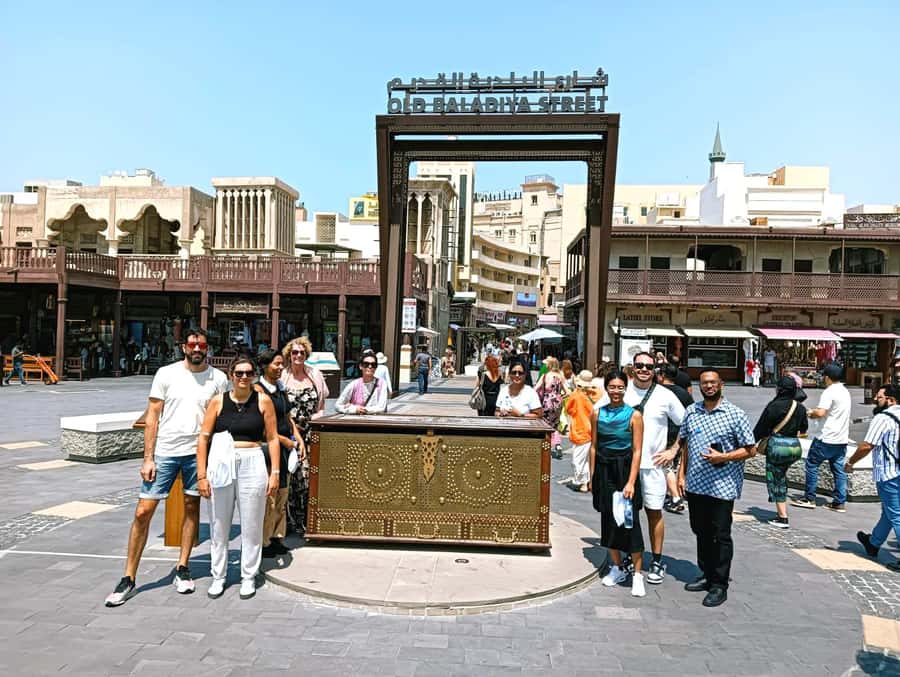
For many people, Dubai means glass towers, huge malls, and air-conditioned attractions. Those places have their place, but this walk shows you the older trading city that came before the high-rises. You’ll move through Al Seef and Al Fahidi, where courtyards, wind towers, mosques, markets, and the creek explain how Dubai developed.
I like that the route is not only a list of photo stops. Your guide explains Emirati lifestyle, local currency, religious customs, coffee traditions, and the growth of the city. That context helps you read the streets instead of simply passing through them.
The strongest part of the experience is the guide-led storytelling. Hesham has been praised for learning everyone’s name, answering questions, and explaining local culture with warmth. Abdullah is also noted for giving detailed explanations and keeping the group at a comfortable size. The exact guide may vary, but the tour is designed around live English commentary rather than an audio guide.
At $16 per person, the price is low for a three-hour guided walk that includes an abra ride and several tastings. You are paying for a broad introduction, not a private tour or a long food crawl. If you want a relaxed route with plenty of time in each market, this may feel brisk. If you want to see the old city efficiently, the price is hard to fault.
More Souk Walks in Dubai
- Dubai: Old Town, Creek, Museums, Souks, & Street Food Tour
★ 4.8 · 10,816 reviews - Dubai: Old Town, Souks, Street Food, Guided Tour & Abra Ride
★ 4.9 · 7,170 reviews - Dubai: Frame Tickets, Creek, Souks & Blue Mosque Guided Tour
★ 4.8 · 5,980 reviews
Starting at Al Seef beside Dubai Creek
The meeting point is Wokyo Noodle Bar, House 10, at Al Seef near Al Fahidi Abra Station. This is a useful starting point because Al Seef sits directly beside Dubai Creek and makes the contrast between old and new Dubai easy to see.
You should arrive ready to walk. Comfortable shoes matter more than smart clothes here, and cash is worth carrying for optional purchases in the souks. The nearest metro station is Sharaf DG on the Green Line, followed by a short walk. Free parking is available near the meeting point, according to the supplied details.
Al Seef is both a practical meeting area and the first sightseeing stop. You’ll have time to look around, shop, and hear how the creek supported Dubai’s early trade. The area has been developed for visitors, so it is not the most untouched part of old Dubai, but it provides an easy introduction before the route moves into Al Fahidi.
Al Fahidi Fort and the oldest neighborhoods
The walk continues toward Al Fahidi Fort, where you’ll stop for photographs and hear more about Dubai’s past. The fort is one of the key historic sights on the route, and the nearby heritage area gives you a sense of the city before oil wealth and large-scale construction changed its shape.
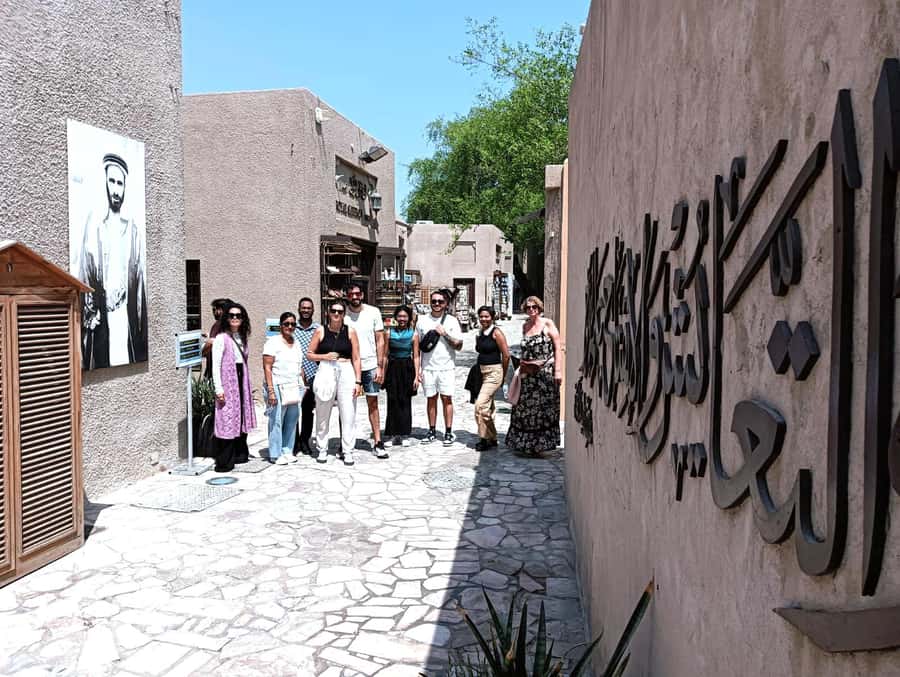
From here, the route enters Al Bastakiya, also called the Al Fahidi Historical Neighborhood. You’ll see old houses, narrow lanes, courtyards, and traditional architectural details. The tour information highlights the oldest houses in Dubai, and your guide helps explain how these buildings relate to local life and the climate.
This is where the tour’s pace matters. You are walking through an area designed for looking closely, not rushing from one landmark to another. You might pause for photographs, listen to stories about Emirati homes, and learn about the local currency and heritage area.
The neighborhood is also one of the more atmospheric parts of the experience, but keep your expectations sensible. This is a compact historic quarter within a modern city, not a preserved rural village. Its value comes from seeing the architectural ideas and cultural details that remain visible in central Dubai.
Coffee, tea, and the oldest mosque
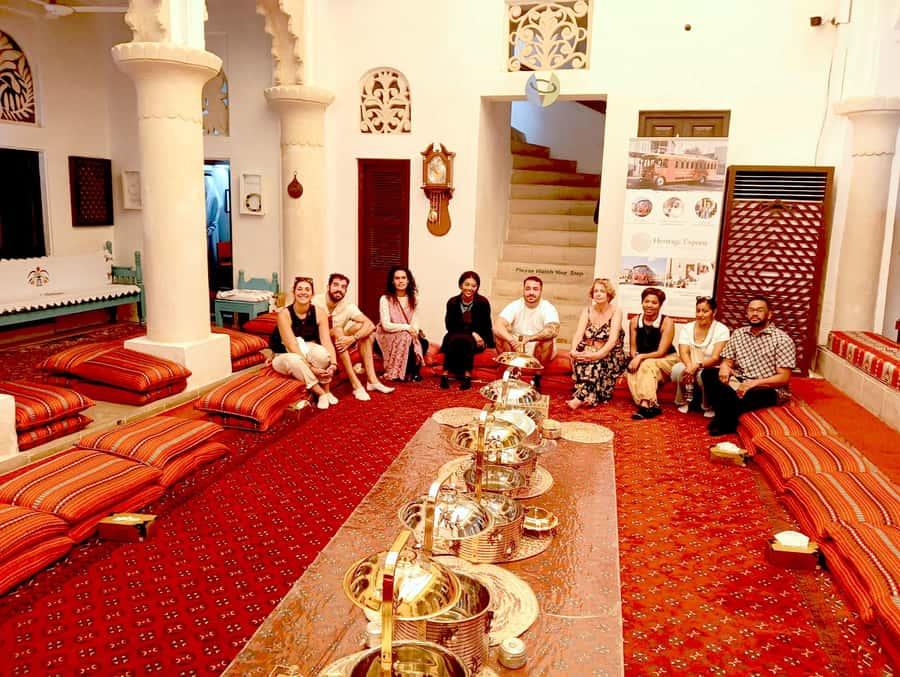
The route passes the Coffee Museum, a fitting stop in a region where coffee hospitality carries social meaning. The tour includes Arabic coffee, tea, water, and refreshing beverages, although the exact timing of each tasting may depend on the guide and conditions on the day.
You’ll also pass the Arabian Tea House, a well-known restaurant serving local food. The tour does not describe a full meal there, so think of this as a landmark and cultural reference rather than a restaurant reservation.
Another important stop is Dubai’s oldest mosque. Your guide shares religious facts and explains aspects of local practice. This is useful because it gives the walk more depth than a simple market visit. You are not only looking at buildings. You are learning how religion, hospitality, trade, and family life shape the city.
The tour is conducted in English. It is not suitable for people with hearing impairments, and the walking format may not suit anyone who finds three hours on foot difficult. People over 95 are also listed as unsuitable for the activity.
Same base, a different sort of day:
- Dubai: Burj Khalifa Levels 124 & 125 Entry Ticket + Options
★ 4.3 · 90,891 reviews - Dubai: Desert Safari, Quad Bike, Camel Ride & Al Khayma Camp
★ 4.9 · 68,962 reviews - Dubai: Desert Safari, Quad Bike, Camel Ride and Sandboarding
★ 4.9 · 43,505 reviews - Dubai: Safari, Quad Bike, Camel Ride, and Buffet Dinner
★ 4.9 · 33,424 reviews
Al Souq Al Kabeer and the food stops
Al Souq Al Kabeer brings the shopping and tasting side of the walk into focus. You’ll have free time to try street food, tea, and camel milk chocolate while browsing the market.
This is one of the tour’s most useful features for first-time visitors. A guide can point out foods and drinks you might otherwise pass without understanding. The tastings are small parts of a wider walk, so do not book this expecting a large meal.
Camel milk chocolate is a particularly distinctive inclusion. It gives you a taste associated with the region without requiring you to commit to a full unfamiliar dish. Arabic coffee and tea add another layer, since they connect food with welcome and daily social customs.
The free time also lets you make your own choices. You can browse, ask questions, take photographs, or focus on tasting. The trade-off is that market time can feel less structured than the guided sections. If you enjoy independent browsing, that is a plus. If you prefer every minute planned, you may want clearer instructions from the guide about how long to spend in each area.
During Ramadan, street food, coffee, and tea are not provided. This is an important point, since the tastings are part of the advertised value. The walking tour and cultural explanations still take place, but you should not count on the food element during the holy month.
Crossing Dubai Creek by traditional abra
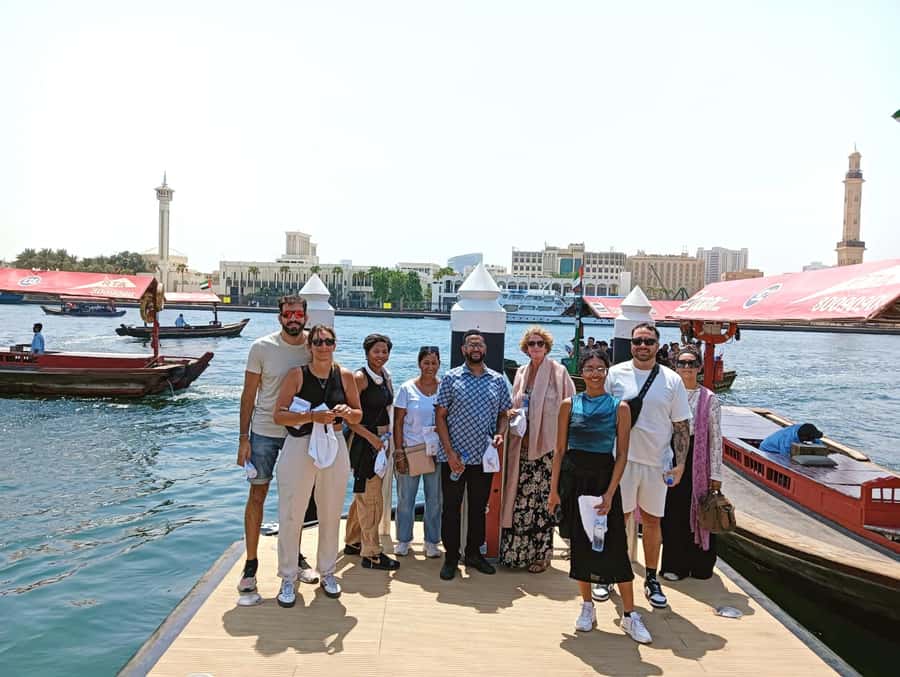
At Bur Dubai Abra Dock, you’ll take a traditional abra across Dubai Creek. This short boat ride is one of the tour’s most appealing details because it connects the two halves of the route in a way that reflects the creek’s practical importance.
You get a different view of Dubai from the water, even during a brief crossing. The ride also breaks up the walking and gives you a chance to sit down for a moment. It is a working-style local boat experience rather than a sightseeing cruise, so keep the scale modest.
The abra is not a substitute for a longer creek cruise. Its value is in the connection: you leave the old neighborhoods around Al Fahidi and arrive near the Spice Souk and Gold Souk. That physical crossing helps the tour feel like a journey through several parts of old Dubai rather than one enclosed heritage district.
The Spice Souk, with scents and bargaining
On the Deira side of the creek, the Spice Souk changes the mood. You’ll see shops filled with spices and other market goods, and your guide can help explain what you are looking at and how the souk fits into Dubai’s trading tradition.
This is a good place to slow down and use your senses. Smells, colors, displays, and shopkeepers make the market feel very different from the polished retail spaces elsewhere in Dubai. You might find items you want to buy, but you do not need to purchase anything to enjoy the stop.
Shopping is part of the tour, not an obligation. Carrying cash is sensible, and you should treat buying as optional. As in many tourist markets, prices may not always be displayed in a way that makes comparison easy. Listen to your guide, ask questions, and take your time before agreeing to a purchase.
The Spice Souk can be busy, and the route may require you to stay close to the group. That is normal for a market walk. If you want long, quiet stretches for photography, this is not the right setting. If you want an introduction to the sights and sounds of old Dubai commerce, it works well.
Finishing at the Gold Souk
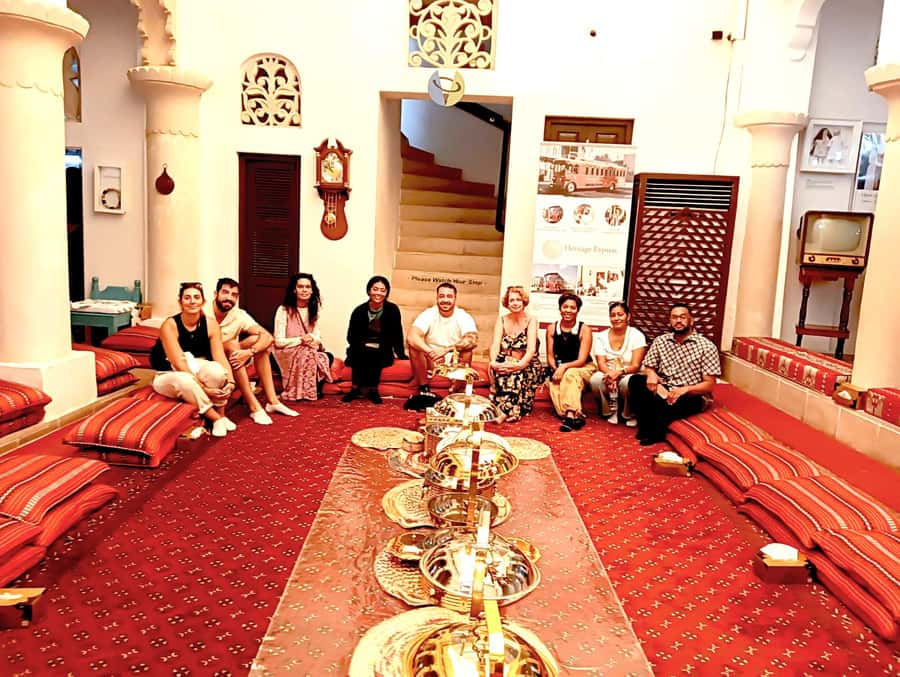
The tour ends at the Dubai Gold Souk, one of the largest gold markets in the world. This gives the final section a clear purpose and leaves you in a useful area for continuing on your own.
You’ll see shop windows filled with gold jewelry and elaborate displays. Even if you have no interest in buying, the scale of the market makes it an impressive final stop. The guide can provide background, but the tour is not presented as a jewelry-buying service or appraisal.
Ending here is convenient if you want to keep exploring Deira. It also means you are not returned to Al Seef. Plan your onward route before you begin, especially if you have an evening booking elsewhere. The lack of pickup and drop-off is one of the few practical limitations, but it keeps the price low and leaves you free to continue in the old city.
Guide style, pace, and group experience
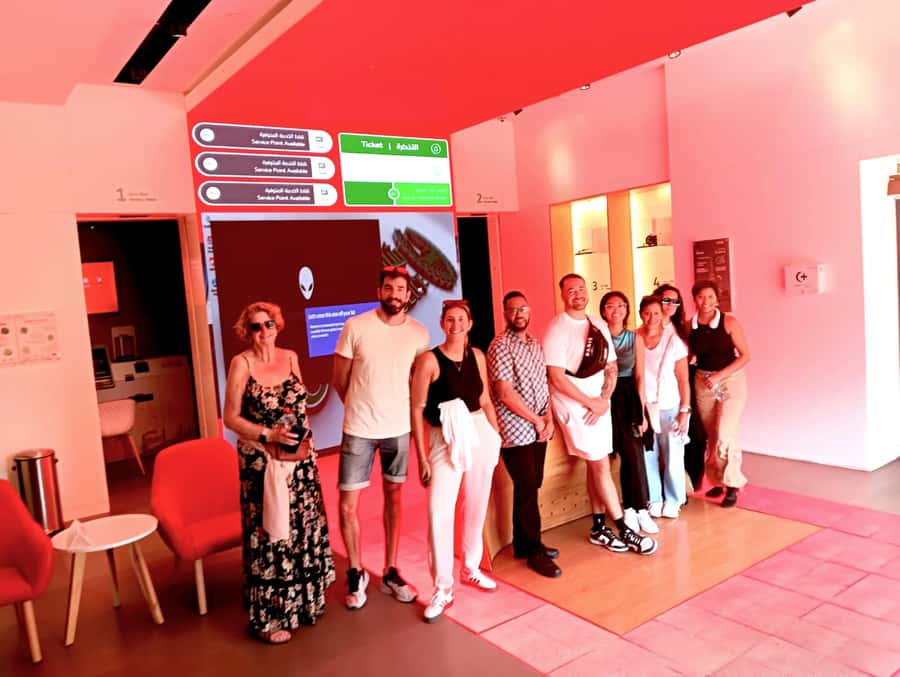
The guide can make or break a walking tour, and the strongest praise here focuses on personal attention and storytelling. Hesham is noted for learning each participant’s name, answering questions, and explaining the history, culture, and traditions of the United Arab Emirates. One account also highlights his good humor while fasting during Ramadan.
Abdullah is described as highly informative and responsive to questions, with a pleasant group size. Those details suggest a tour where you can ask questions rather than simply follow a flag through the streets.
Still, guide quality can vary from one departure to another. The activity is conducted in English, and it is not suitable for people with hearing impairments. You should also expect outdoor walking, market crowds, uneven stretches, and warm conditions depending on the season and time of day, although the supplied information does not specify the exact start times.
Is $16 a fair price?
Yes, if you want a broad introduction to old Dubai. For $16, you receive three hours with a live guide, an abra ride, local drinks, food tastings, camel milk chocolate, and access to a route covering Al Seef, Al Fahidi, the creek, the Spice Souk, and the Gold Souk.
The value is strongest for first-time visitors and people with limited time. You get a practical orientation to several districts without arranging separate transport between them. The guide also adds cultural background that you would miss by wandering through the markets alone.
The price does not include hotel pickup or drop-off, and it does not promise a full lunch. Food tastings are modest, and Ramadan changes what is available. You are also paying for a shared walking experience, not a private guide who can stop whenever you like.
The booking terms are flexible: you can cancel up to 24 hours ahead for a full refund, and reserve now while paying later. Availability and starting times should be checked when booking.
Who should book this old Dubai walk?
I would recommend it to you if this is your first visit to Dubai, you want to see the city beyond its modern center, or you enjoy learning through food and conversation. It is also useful for anyone who wants to visit the souks but would prefer some guidance before browsing alone.
It suits curious walkers who can manage three hours on foot and enjoy a mix of history, architecture, religion, food, shopping, and local transport. It is less suitable if you want a luxury experience, a private tour, a full meal, or a slow photographic walk with no fixed schedule.
Should you book it?
Book this tour if you want a low-cost, well-rounded introduction to old Dubai with a guide who can connect the markets and historic streets to Emirati life. The abra ride, camel milk chocolate, Arabic coffee, and final walk through the Gold Souk give it more variety than a basic neighborhood stroll.
Skip it if your main goal is modern Dubai, if you dislike walking and market crowds, or if you are visiting during Ramadan mainly for the food tastings. For most first-time visitors with three free hours, though, this is a practical way to see the older side of the city and finish with plenty of ideas for exploring on your own.
FAQ
How long does the Dubai old town tour last?
The tour lasts three hours. Starting times vary, so check availability when you book.
Where does the tour begin?
Meet at Wokyo Noodle Bar, House 10, near Al Fahidi Abra Station at Al Seef beside Dubai Creek.
Where does the tour finish?
The tour ends at the Dubai Gold Souk.
Is the tour conducted in English?
Yes. The activity includes a live English-speaking guide.
Is the abra boat ride included?
Yes. A traditional abra boat ride across Dubai Creek is included.
What food and drinks are included?
The experience includes local street food, Arabic coffee, tea, water, refreshing beverages, and camel milk chocolate tasting. Street food, coffee, and tea are not provided during Ramadan.
Is hotel pickup included?
No. Pickup and drop-off are not included. You must make your own way to the Al Seef meeting point and arrange transport after the tour.
More Food in Dubai
- Dubai Top Highlights: Frame Entry, Souks, Abra & Street Food
★ 4.8 · 344 reviews - Dubai: Premium Old Town, Street Food, Souks & Boat Ride Tour
★ 4.9 · 262 reviews - Dubai: City Highlights Tour with Blue Mosque & Street Food
★ 4.6 · 247 reviews - Dubai.Discover Old town,Markets,street food,Abra &Museums
★ 4.9 · 181 reviews
More Food & Drink in Dubai
- Dubai: Old Town, Souks, Street Food, Guided Tour & Abra Ride
★ 5.0 · 1,664 reviews - Dubai: Old Town, Street Food, Creek, Souks, & Emirati House
★ 4.9 · 1,496 reviews - Old Dubai tour: Local Market, Tasting, Dubai creek with Abra ride
★ 5.0 · 834 reviews - Old Dubai: Premium Guided Tour with Street Food & Abra Ride
★ 4.9 · 416 reviews
Just added in Dubai
- From Dubai/Sharjah/RAK: Dibba Musandam Trip & Dhow Cruise★ 4.4 · 232 reviews
- From Dubai: Zerzura Dune Buggy Experience & Fossil Discovery★ 4.9 · 48 reviews
- From Dubai: Hatta Sightseeing Tour with kayaking★ 4.9 · 53 reviews
- From Dubai: Try Scuba Diving, Snorkeling with BBQ & Transfer★ 4.9 · 22 reviews
- From Dubai to Norway of Arabia|Telegraph Island| Dhow Cruise★ 4.9 · 91 reviews
- Dubai: Desert Safari, Camel Ride, and BBQ Dinner★ 4.0 · 192 reviews
- From Dubai: Discovery Scuba Diving & Snorkeling In Fujairah★ 4.9 · 93 reviews
- From Dubai: Fujairah Half-Day Scuba Dive and Snorkeling★ 4.7 · 186 reviews
Tours in Dubai, compared.

Burj Khalifa Levels 124 & 125 Entry Ticket + Options
Read our review →
Desert Safari, Quad Bike, Camel Ride & Al Khayma Camp
Read our review →
Desert Safari, Quad Bike, Camel Ride and Sandboarding
Read our review →
Safari, Quad Bike, Camel Ride, and Buffet Dinner
Read our review →
Red Dune Safari, Quad Bike, Camel Ride, BBQ Dinner
Read our review →
Premium Safari, Camel Ride & Al Khayma Camp 3-Buffets
Read our review →
Burj Khalifa Sky Level 148, 124, & 125 Entry Ticket
Read our review →
The View At The Palm Observatory Entry Ticket
Read our review →Browse the lists this tour appears in