
Reviewed · TOURS IN AMMAN
Private Tour, Jerash and Amman City Tour
Jerash is the star here: a remarkably complete Roman city where the Oval Colonnade, temples, theaters, fountains, and stone streets make ancient urban life easy to picture. Then you return to Amman for two very different views of the capital, from the hilltop Citadel to the steep Roman Theater.
I like the private minivan, which lets you set the pace, and I like the range of the day. In one outing, you see a major archaeological site and Amman’s best-known classical monuments. The main drawback is that the base outing is driver-led, not a fully guided tour, and admission fees may be extra depending on the option you choose.
Key points to know before booking
- Jerash gets about three hours: Enough time for the main monuments, though the site is large and exposed.
- A local Jerash guide is optional: Choose the upgrade if you want detailed explanations rather than independent sightseeing.
- Amman’s Citadel and Roman Theater complete the day: You get hilltop ruins, museum displays, city views, and a restored theater.
- Private transport keeps the schedule flexible: Hotel pickup, drop-off, bottled water, onboard WiFi, and air-conditioning are included.
- The price is $83 per person: This is strongest value for a small group that would otherwise need separate transport and admissions.
- The Jordan Pass may reduce entry costs: One person specifically advised checking it, since site fees are not generally included in the base price.
Why Jerash deserves the morning
The drive from Amman to Jerash covers roughly 48 to 50 kilometers, or about 31 miles, heading north through Jordan’s dry, rugged countryside. The trip takes about an hour, depending on traffic and your pickup point. With a private vehicle, you avoid arranging a taxi or bus and can use the ride to ask your driver about Jordan, Amman, and the day ahead.
Jerash grew from a settlement founded around the second century BC and later prospered under Roman rule. It became one of the Decapolis cities, a group of important towns in the eastern Roman world. The site you see today is not a single isolated ruin, but a broad ancient city with streets, public buildings, religious centers, theaters, and water features.
Allow about three hours here. That sounds generous, but Jerash covers enough ground that you will want time for photos, short pauses, and the climb to the theaters. The stone can be uneven, and much of the site is open to the sun, so comfortable shoes, water, and a hat are sensible.
More City Tours in Amman
- Amman Private City Tour & more.
★ 4.5 · 66 reviews - Amazing Panoramic Amman City Tour
★ 4.5 · 57 reviews - Amman: Private Sightseeing City Tour
★ 4.2 · 42 reviews
Walking through Hadrian’s Arch and the Hippodrome
Your first major sight is Hadrian’s Arch, built around AD 130 to mark Emperor Hadrian’s visit. Its scale gives you an immediate sense of Jerash as a city built to impress. It also makes a useful starting point for understanding the layout before you move farther into the ruins.
Nearby, the Hippodrome once held about 15,000 spectators. This long arena helps explain that Jerash was not simply a religious center. It was a working city with public entertainment, commerce, ceremonies, and a large population.
A private outing is useful here because you can linger at the places that catch your eye. If you are fascinated by Roman engineering, you may want more time with the streets and columns. If temples and theaters interest you most, you can move on without waiting for a group.
The Oval Colonnade and Temple of Artemis
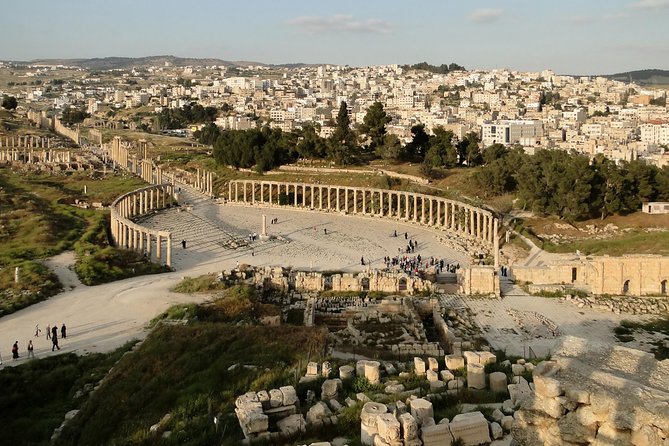
The Forum and its Oval Colonnade are among Jerash’s most memorable sights. The curved arrangement of columns creates a broad open space and gives the ruins a strong sense of design. From here, you can look along the ancient street and see how the city was organized around public gathering places.
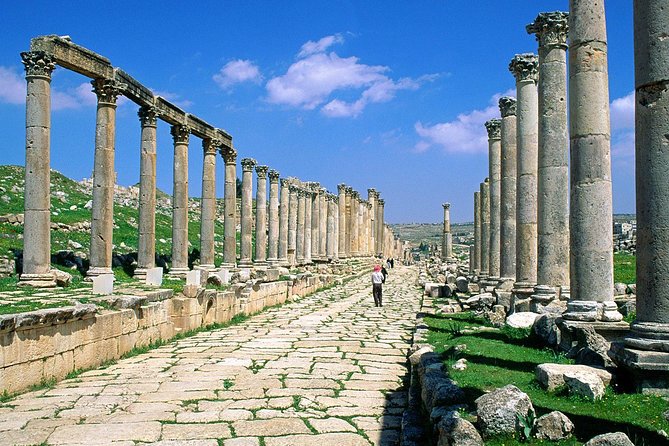
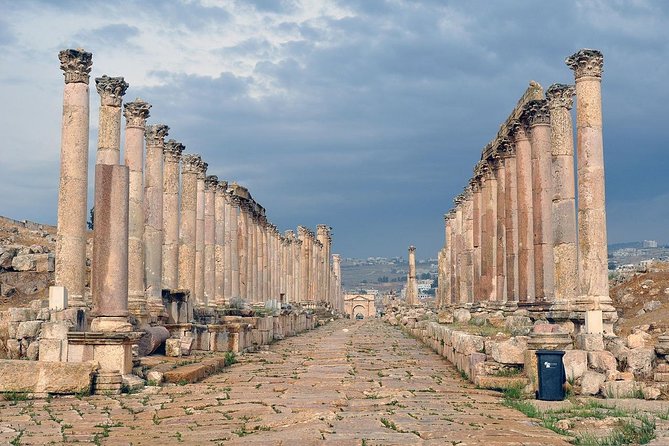
The Colonnaded Street leads you farther into Jerash. Its long line of columns is one of the site’s best photo locations, but do not rush through it. Look down at the paving stones and notice the scale of the road. This is where the ancient city feels most like a real place rather than a collection of disconnected monuments.
The Temple of Artemis is another major stop. Its Corinthian columns rise about 12 meters, or 39 feet, and give the temple a powerful vertical presence. Artemis was the city’s patron goddess, so this was not a minor neighborhood shrine. The remaining columns are enough to show the temple’s former importance, even though the building itself is incomplete.
You will also see the Nymphaeum, an ornamental fountain that once supplied a major public setting with water and decoration. These details matter because they show the city’s daily side. Jerash was not only about emperors and gods. It was also about public space, water, movement, and social life.
Choosing the local guide option at Jerash
The standard arrangement lets you explore Jerash independently while your driver handles transportation. That can work well if you have already read about the site or prefer to move at your own speed.
The optional local guide is worth considering if you want help identifying buildings and understanding how the city developed. A guide can also make it easier to connect the Forum, theaters, temples, fountains, and streets into one clear story. The information provided does not name the local guide in advance, so confirm that detail when booking if it matters to you.
Your driver may still provide useful context. Yusuf was praised for explaining the sites, the city, and local customs, while Mohammed Bardaghawi was singled out for cultural information and careful service. Saadah was described as polite and English-speaking, and Abu Anas was praised for providing good information along the way. Still, driver commentary is not the same as a dedicated archaeological guide, so choose the upgrade if detailed interpretation is a priority.
More City Tours in Jordan
- Amman City Tour From Amman
★ 4.8 · 33 reviews
Returning to Amman for the Citadel
After Jerash, you return to Amman for the city portion of the outing. The Citadel sits on a hilltop with broad views over Amman’s pale stone buildings. It is an excellent place to understand the capital’s shape, especially since Amman spreads across several hills and valleys.
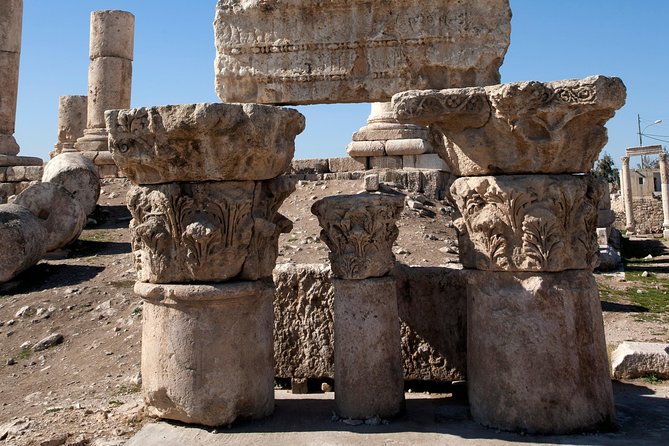
The site brings together remains from different periods. You can see the Roman Temple of Hercules, dating from the second century, along with the Umayyad Palace, a complex of royal buildings from the eighth century. The combination is what makes the Citadel so worthwhile. You are not looking at one neatly separated historical period. You are walking through layers of Roman, Byzantine, and early Islamic Amman.
The hill also means some walking on uneven ground and slopes. The time allotted here is about two hours, which gives you room for the ruins, views, and the Archaeological Museum. If you have limited energy late in the day, tell your driver. The benefit of a private outing is that the schedule can be adjusted within reason.
The Archaeological Museum adds useful context
The museum at the Citadel displays classical and Islamic finds from across Jordan. It is a smaller stop than Jerash, but it can make the ancient sites easier to understand. After seeing huge columns and theaters outdoors, you get a closer look at objects and archaeological material.
I would not treat this as a separate museum day. It works best as a short, focused visit during the Citadel stop. Use it to connect what you have seen at Jerash and Amman with the smaller objects that reveal how people lived, worshiped, and worked.
Descending to Amman’s Roman Theater
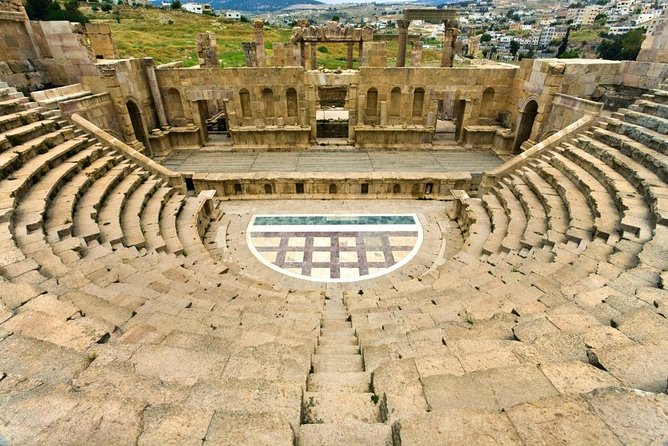
The Roman Theater is in downtown Amman, carved into the hillside of Jabal Al-Jozfah. Built around AD 161 during the reign of Antoninus Pius, it could hold about 6,000 people. Its steep seating gives you a good view of the stage and a sharp reminder of how Roman theaters used hills to solve practical building problems.
The theater has about 44 tiers of limestone seats. You can climb partway up for a view across the stage and the city, though the steps are steep and uneven. The stage facade, with Corinthian columns and carved details, has been restored enough to make the original design clear.
The site’s later use adds another layer. It served as a Christian church in the Byzantine period and later became a marketplace under Ottoman rule. That changing purpose is useful to remember: old buildings in Jordan were often reused rather than simply abandoned.
Plan on about 30 minutes here. That is enough for the main view, a few photos, and a look at the architecture. If the theater is especially important to you, confirm the stop with your driver before the tour begins. One booking received a lower rating because the Roman Theater was missed, so clear communication matters.
A brief look at Amman’s traditional markets
The day may finish with a closer look at Amman’s traditional souks. The supplied itinerary also mentions Souq Jara, with spices, handicrafts, and local goods. The market portion is not timed as precisely as the main archaeological stops, so ask how much time is available if shopping is important to you.
This is a useful change of pace after a day of stones and monuments. You can see the living city, browse local items, and ask your driver for suggestions. Several drivers were praised for offering restaurant advice and ideas for other places to visit.
A few travelers also received extra stops or small local touches, such as snacks, help with souvenirs, or a visit to the blue-domed King Abdullah I Mosque. Do not assume these additions are guaranteed, but you can ask politely if your schedule allows. The core route remains Jerash, the Citadel, and the Roman Theater.
What the private vehicle changes
The private air-conditioned minivan is more than a comfortable way to get around. It removes the need to arrange separate transport between Amman and Jerash, then navigate the capital’s hills and downtown traffic. Hotel pickup and drop-off also make this easier on a first day in Jordan.
The tour is private, so only your group participates. That gives you more control than a large coach excursion. You can spend longer at the Temple of Artemis, move faster through a stop that interests you less, or ask for practical advice about restaurants and nearby sights.
The experience is not a formal private guiding service at every stop. In the base arrangement, your driver is primarily responsible for transport. Some drivers have acted as informal guides, answering questions and explaining culture, but that depends on the person assigned to your group. If you want sustained historical commentary, pay for the local guide option at Jerash and confirm what guidance is provided in Amman.
Is $83 per person good value?
At $83 per person, the price makes the most sense for a small group that wants a full day without arranging taxis, negotiating fares, or managing the route alone. You receive private transportation, hotel pickup and drop-off, bottled water, and WiFi in the vehicle.
Entry fees are the main point to check carefully. The base information lists site admission as not included, while the booking options may include admission fees if selected. Read the exact option before paying. A Jordan Pass may also help if you are visiting several paid sites in Jordan, so compare its cost with the admissions you expect to use.
The value is less convincing if you only want a short visit to Amman or if you plan to visit Jerash by another method. For a first full day, though, the route covers a lot of ground and saves you the trouble of fitting these sights together yourself.
Who will enjoy this day most?
I would recommend it to first-time visitors who want a clear introduction to Amman and Jerash. It also suits families and small groups that value a private vehicle, since you are not tied to a large group’s pace.
History fans should choose the local Jerash guide if possible. Independent sightseers may prefer the standard option, especially if they want time for their own photographs and do not need constant explanation.
This is less suitable if you dislike walking, steep steps, sun, or uneven ancient paving. The tour lasts about five to eight hours, with the advertised schedule near seven hours, so it is a full outing. You can ask for flexibility, but you should still expect a busy day.
The experience has a 4.9 rating from 39 ratings and is recommended by 97 percent of participants. The strongest pattern is dependable pickup, comfortable vehicles, friendly drivers, and flexible pacing. The main caution is simple: confirm the Roman Theater stop, admission arrangement, and guide option before setting off.
Should you book the Jerash and Amman tour?
Book it if you want the easiest way to combine Jordan’s finest Roman ruins with Amman’s essential sights in one day. The route is well chosen, and the private format gives you comfort and room to adjust the pace.
I would choose the guide upgrade at Jerash if the ancient city is your main reason for booking. I would also confirm that the Roman Theater is included, ask which admissions are covered, and check whether the Jordan Pass saves money for your wider Jordan trip.
Skip it if you prefer a slow, single-site visit or want a fully guided experience from start to finish. For most first visits, though, this is a practical and worthwhile introduction to both Jerash and Amman.
FAQ
How long does the private Jerash and Amman tour last?
The experience lasts approximately five to eight hours, with the advertised schedule close to seven hours.
Is hotel pickup and drop-off included?
Yes. Pickup and drop-off at your Amman hotel are included.
Is a local guide included at Jerash?
A local Jerash guide is optional. You can select the guide upgrade when booking.
Are admission fees included?
The base information lists entry fees as not included, although some booking options may include admission. Check the exact option you select. The Jordan Pass may also help with entry costs.
What sights are visited in Amman?
The route includes the Amman Citadel, the Archaeological Museum, and the Roman Theater. It may also include traditional souks, and the itinerary mentions the King Abdullah I Mosque and Souq Jara.
Is this a private tour?
Yes. Only your group participates, and transport is provided by private, air-conditioned minivan.
Just added in Amman
- From Amman: Private Petra Day Trip with Guide★ 4.8 · 64 reviews
- From Amman:To Al-Mujib Canyon & Dead Sea Salt Beach Day Trip★ 4.7 · 32 reviews
- From Amman: Petra & Wadi Rum Private/Group Full Day Tour★ 4.7 · 28 reviews
- From Amman: Petra, Wadi Rum, and Dead Sea Private 2-Day Trip★ 5.0 · 103 reviews
- From Amman: Umayyad Desert Castles Tour with Transfer★ 4.5 · 69 reviews
- From Amman: Private Day Trip to Petra with Pickup★ 4.8 · 129 reviews
- From Amman: Private Jerash, Ajloun Castle, and Umm Qais Tour★ 4.9 · 82 reviews
- From Amman: Petra and Dead Sea Day Trip★ 4.9 · 39 reviews
Tours in Amman, compared.
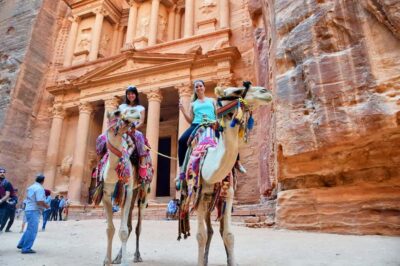



3-Day Private Tour from Amman: Petra, Wadi Rum, Dana, Aqaba, and Dead Sea
Read our review →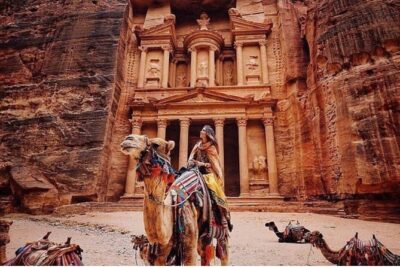
Amman Walking Tour: Hidden Gems, Culture & Street Food
Read our review →
Private Tour to Madaba, Mount Nebo, and Baptism Site
Read our review →Browse the lists this tour appears in