
Reviewed · JERUSALEM & BETHLEHEM TOURS
Jerusalem: Guided Walking Tour of the Old City
Jerusalem’s Old City packs thousands of years of faith, conflict, and daily life into a maze of narrow lanes. This four-hour walk takes you from Jaffa Gate through the city’s four quarters, with stops at the Western Wall, Via Dolorosa, Church of the Holy Sepulchre, and the Temple Mount area.
I like two things especially: the guide gives the three major faiths room to speak, and the route helps you understand how the sites fit together rather than viewing them as isolated monuments. Guides such as Tania, Shahar, Yoni, and Alex have been praised for clear English, patient answers, humor, and a calm pace.
The main drawback is physical. You will walk for four hours over stone lanes, steps, slopes, and crowded passages. Temple Mount access also depends on the day, religious holidays, and local rules, so the Dome of the Rock and Al-Aqsa Mosque may be replaced by a viewpoint.
Key points to know before you book
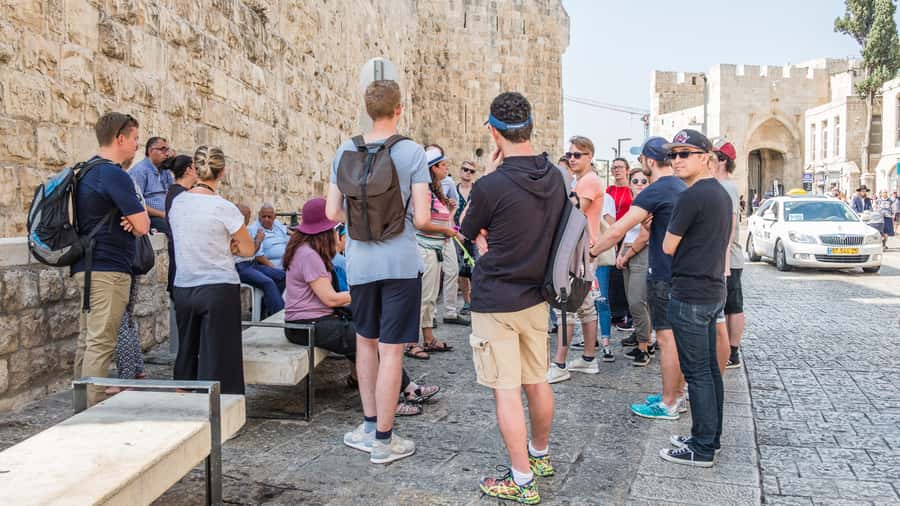
- Start at Jaffa Gate: Meet at the stone bench just outside the gate and look for a guide in a green shirt marked Guide in yellow on the back.
- Cover the Old City’s four quarters: The walk links Jewish, Muslim, Christian, and Armenian areas in one route.
- See Jerusalem’s central holy places: Expect the Western Wall, Via Dolorosa, Church of the Holy Sepulchre, and a visit or viewpoint for the Temple Mount.
- Plan for serious walking: Wear comfortable shoes, carry water, and bring a sun hat and scarf.
- Dress with care: Shorts and sleeveless shirts are not allowed, and modest clothing matters at religious sites.
- Use it as an introduction: The tour gives you a strong first look, but you will still want extra time to explore the Old City on your own.
Starting at Jaffa Gate and entering the Old City
Jaffa Gate is a useful meeting point because it is one of the Old City’s best-known entrances. Look for the stone bench just outside the gate, then find the guide wearing a green shirt with Guide printed in yellow on the back.
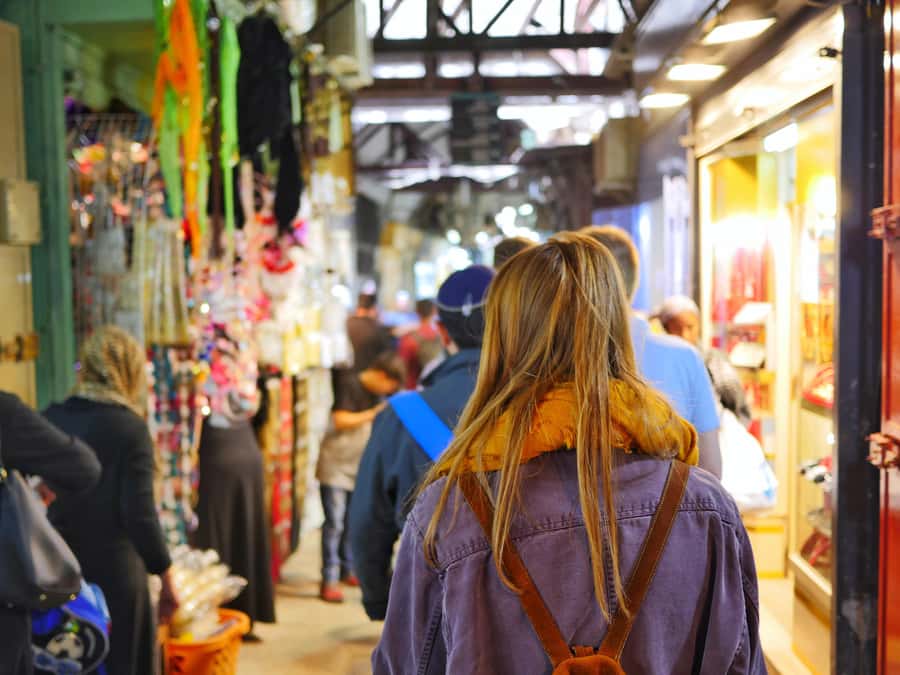
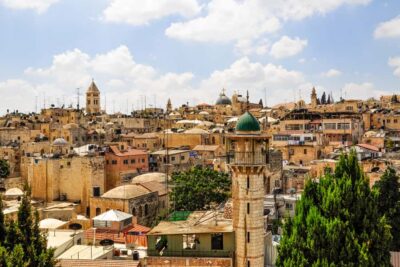
Once the group gathers, the walk moves into the Old City’s tight lanes. This is not a coach tour with a window view. You are on foot, close to the stone walls, market stalls, worshippers, shopkeepers, and residents who make the Old City feel like a living neighborhood rather than an open-air museum.
The guide’s role matters here. It is easy to lose the thread when one lane leads into another and several faiths claim the same ground. The strongest guides on this tour, including Tania, Shahar, Yoni, Tanya, and Alex, have been praised for explaining difficult subjects in plain English and answering questions without turning the walk into a political lecture.
That balance is important in Jerusalem. You are not simply looking at old stones. You are moving through places that remain central to Jewish, Muslim, and Christian worship today.
More Souk Walks in Israel
- Best seller! Jerusalem old city four quarters tour
★ 5.0 · 123 reviews - Private Tour Jerusalem Old City
★ 5.0 · 118 reviews - All Inclusive Walking Tour Old City Jerusalem
★ 5.0 · 83 reviews
The Jewish Quarter and the Western Wall
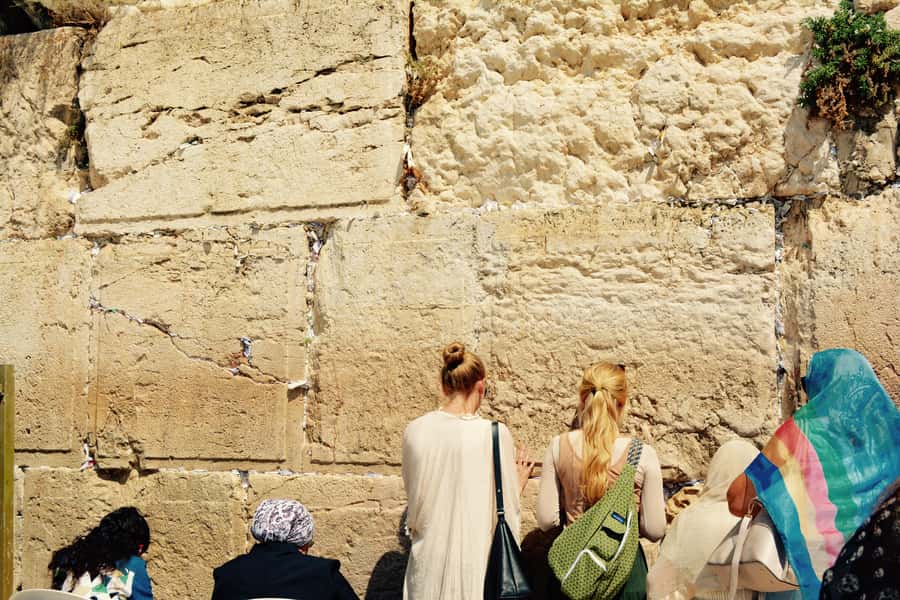
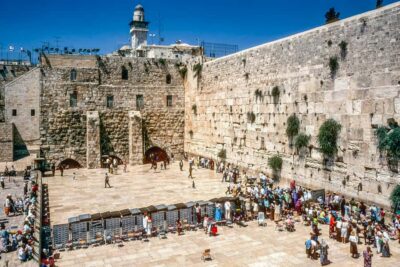
The Jewish Quarter brings the tour to one of Jerusalem’s most important Jewish sites, the Western Wall. It is the surviving retaining wall connected with the Temple Mount, and Jewish prayer has centered here for centuries.
Your guide places the wall in the story of the ancient Jewish Temple and the formation of the Jewish nation. That context helps you understand why the site matters beyond its physical size. The wall is not a grand building with a large interior. Its power comes from memory, prayer, and the continuity of a place used across generations.
You should expect a serious atmosphere near the prayer area. Men and women use separate sections, and visitors should follow the local signs and customs. Modest clothing is essential. Since you will later visit Christian and Muslim holy places, a scarf and clothing that covers the shoulders and knees are practical choices for the whole morning.
One particularly strong part of this walk is the guide’s ability to connect the Western Wall with the Temple Mount above it. You see how a single hill carries different religious meanings, and why access, prayer, and public visits can be sensitive.
The time at each stop depends on the group and the day. You may hear more than you can absorb in one sitting, so take mental notes and return later if the wall becomes a highlight for you.
The Temple Mount, Dome of the Rock, and Al-Aqsa Mosque
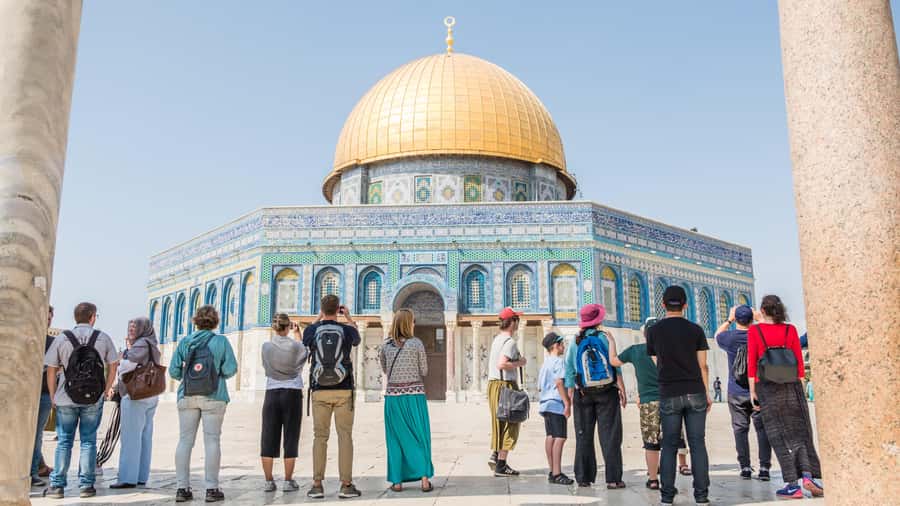
The Temple Mount is the point where the tour’s religious and practical limits become most important. The area includes the Dome of the Rock and Al-Aqsa Mosque, sites of major importance to Islam and among Jerusalem’s most recognizable landmarks.
The tour explains the Islamic meaning of the site, including the tradition that the Prophet Mohammed ascended to heaven here. You will also hear about the Five Pillars of Islam and the place of the Temple Mount within Jerusalem’s wider story.
Access is not guaranteed. The Temple Mount, including the Dome of the Rock and Al-Aqsa Mosque, is closed to visitors every Friday and Saturday, along with various Muslim and Jewish holidays. When it is closed, the tour includes a viewpoint overlooking the area instead.
That change does not make the walk pointless, but it does alter the experience. A viewpoint gives you a useful sense of the layout and allows the guide to explain the buildings from outside. You will not get the same close look at the complex, so check the date of your tour if seeing the interior area is especially important to you.
Rules can also change. Bring your passport, or a copy, as requested in the tour information. Follow the guide’s directions and avoid treating the site as a casual photo stop. The value here is in understanding the place and its meaning, not simply collecting a picture.
Walking the Via Dolorosa
The Via Dolorosa is one of the most emotionally charged parts of the route for Christian visitors. The walk follows the traditional path associated with Jesus carrying the cross toward crucifixion.
The lanes are narrow, and the route runs through an active part of the Old City. Shops, signs, stone walls, and passing groups can make it difficult to picture the ancient setting. That is exactly why a guide helps. Biblical stories are explained at the places connected with them, rather than left as names on a map.
The guide also gives the route a wider setting. You learn how Christian tradition developed around these places and how Jerusalem’s sacred geography took shape. For some people, the stop feels devotional. For others, it is mainly a lesson in history and tradition. The tour can serve both approaches.
Weather changes the mood quickly. In hot weather, the lanes may offer shade, but you still need water and a hat. In rain, the stone streets can become slippery and uncomfortable. One winter group completed the walk during a severe storm, which sounds memorable, but it is a useful warning to check the forecast and wear shoes with a solid grip.
This section may feel more Christian in focus than the rest of the tour. That is natural, since the Via Dolorosa and the Church of the Holy Sepulchre are central Christian places. Still, the full route includes all four quarters and gives time to the Jewish and Muslim parts of Jerusalem as well.
Same base, a different sort of day:
- From Jerusalem: Masada & Dead Sea Full Day Tour with Pick Up
★ 4.5 · 815 reviews - Masada and the Dead Sea Day Trip from Jerusalem
★ 4.5 · 757 reviews - From Jerusalem: Nazareth and Sea of Galilee Tour
★ 4.5 · 588 reviews - From Jerusalem: Half-Day Bethlehem Guided Tour
★ 4.7 · 568 reviews
Inside the Church of the Holy Sepulchre
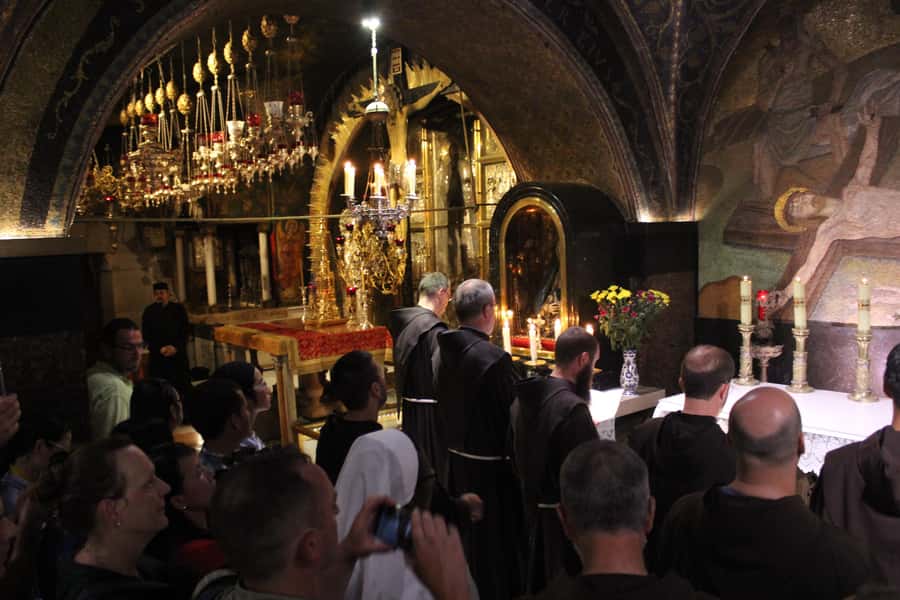
The Church of the Holy Sepulchre is the major Christian stop. It contains places associated with Jesus’s crucifixion, burial, and resurrection, and it is shared by several Christian traditions.
Inside, the experience can feel crowded, solemn, confusing, or all three at once. The church has many chapels and important points, and it is not always obvious what you are looking at or why a particular spot matters. Your guide explains the traditions surrounding the church, including the discovery of the True Cross.
You may see the slab associated with the body of Jesus after the crucifixion, along with other places connected with the final events of the Gospel story. The exact flow through the church can depend on crowd levels, services, and access at the time of the visit, so avoid expecting a quiet, private examination of every site.
I find this stop most useful when you listen for the difference between physical evidence, religious tradition, and centuries of worship. The guide can help separate those layers without taking away from the spiritual meaning.
Give yourself time to look around, but remember that this is a four-hour walking tour with several major stops. If the church matters deeply to you, plan to return independently for a longer visit.
King David’s Tomb and the Last Supper room
The route also includes Christian and Jewish places linked with the final days of Jesus and with King David. King David’s Tomb is important to Jewish tradition, while the room associated with the Last Supper carries strong Christian meaning.
These stops help show how traditions overlap in Jerusalem. They also show why one short walk cannot settle every historical question. Some sites are identified through long-standing religious practice rather than clear archaeological proof, and a good guide explains that difference without dismissing the belief attached to the place.
This is where guide quality becomes especially useful. Tania has been praised for handling religious and historical questions with care, while Shahar and Yoni have been singled out for clear explanations and an easy manner. Guide assignments vary, so you cannot choose a particular person when booking, but the activity has featured several guides who combine facts with stories and humor.
Four quarters, one difficult city
The Old City is divided into Jewish, Muslim, Christian, and Armenian Quarters. You will not experience each one as a neatly separated historical zone. The boundaries overlap, and the route can change quickly from a worship site to a market lane or residential passage.
That mixture is one of the tour’s greatest strengths. You begin to see Jerusalem as a city where faith is part of daily life, not simply a subject in a museum. The guide explains the background while you walk through the actual streets where different communities live, work, pray, and trade.
The tour is also a useful first-day activity. Several people have found that four hours gave them more basic orientation than reading alone. Afterward, you can return to the quarter or site that interested you most, instead of trying to make sense of the entire Old City without a map.
Do not expect every corner to receive equal attention. Four hours sounds long, but Jerusalem has too many sites for a single walk. The route focuses on the best-known religious landmarks and the history needed to understand them.
Pace, group comfort, and the physical effort
The walking pace has generally been described as steady rather than rushed. That matters because the Old City rewards pauses. You need time to look up at a doorway, listen to a prayer, follow the guide through a turn, or ask why a site matters.
Several guides have also been praised for keeping groups together and answering questions patiently. The experience is in English, and clear spoken English is essential when the subject includes names, traditions, dates, and sensitive distinctions.
Still, this is not an easy stroll. The Old City has uneven stone surfaces, narrow passages, and slopes. The tour is not suitable for wheelchair users or people with mobility impairments. If you tire easily, the length and terrain should be a serious part of your decision.
Wear shoes you can trust for several hours. Carry water, especially in summer, and bring a sun hat. A scarf is useful for modesty and sun protection. The tour does not include food or drinks, so plan to eat before or after the walk and carry what you need.
Is $57 a fair price?
At $57 per person, this is not the cheapest way to walk through the Old City, but the price is reasonable if you want a guide who can connect the sites. You are paying for four hours of live English explanation across several quarters, not simply entry to one attraction.
The value is strongest for a first visit. Without a guide, you can certainly reach the Western Wall or Church of the Holy Sepulchre, but it is harder to understand how the sites relate to Jewish, Muslim, and Christian traditions. The tour gives you a working map of Jerusalem and saves you from spending your first day guessing what you are seeing.
The price is less compelling if you prefer slow independent wandering or already know the Old City well. You may also want a separate visit to the church, Western Wall, or Temple Mount if one site is your main reason for coming.
Food and drinks are not included. You may encounter shops and places selling food along the route, but do not treat a meal as part of the package. The walk can run longer than the advertised four hours, as some groups have found, so leave room in your schedule afterward.
Free cancellation up to 24 hours before the activity and the option to reserve now and pay later add useful flexibility, especially when plans in Jerusalem need to remain open.
Who should book this Jerusalem walk?
I would choose this tour for a first-time visitor who wants a clear introduction to the Old City without spending a full day on a private guide. It suits people interested in religion, history, architecture, and the way all three meet in one small area.
Families can enjoy it if children are old enough to manage four hours of walking and listen to stories about several faiths. One guide was praised for using humor and keeping children engaged, but the route remains physically demanding.
The tour also works well for visitors who want a balanced presentation. The strongest reports describe guides who avoid political speeches, skip forced shopping stops, and focus on the sites. That approach is valuable in Jerusalem, where a little context goes a long way.
You should think twice if you need step-free access, dislike crowds, want a quiet spiritual visit, or have only one narrow goal such as entering the Dome of the Rock. Access and timing can change, and the group format cannot guarantee a long, private stop at any one site.
FAQ
Where does the Jerusalem Old City walking tour begin?
Meet at the stone bench just outside Jaffa Gate. Look for the guide wearing a green shirt with Guide written in yellow on the back.
How long does the tour last?
The scheduled duration is four hours. Some groups have found that the walk can last longer, so avoid booking another tight appointment immediately afterward.
What language is the tour conducted in?
The live guided tour is conducted in English.
Which major sites are included?
The route includes the Western Wall, Temple Mount area, Via Dolorosa, and Church of the Holy Sepulchre. It also covers places such as Jaffa Gate, King David’s Tomb, and the room associated with the Last Supper.
Can I visit the Dome of the Rock and Al-Aqsa Mosque?
Access is not guaranteed. Temple Mount, including the Dome of the Rock and Al-Aqsa Mosque, is closed to visitors every Friday, Saturday, and during various Muslim and Jewish holidays. A viewpoint overlooking the area is included instead when it is closed.
What should I bring?
Bring comfortable shoes, water, a sun hat, a scarf, and your passport. A copy of your passport is accepted.
What should I wear?
Shorts and sleeveless shirts are not allowed. Wear modest clothing suitable for religious sites.
Is the tour suitable for wheelchair users?
No. The tour is not suitable for wheelchair users or people with mobility impairments.
Are food and drinks included?
No. Food and drinks are not included in the activity.
Should you book it?
Book this walk if you want the Old City explained as a connected story rather than a string of famous names. The four-hour route gives you the main Jewish, Muslim, and Christian landmarks, while guides such as Tania, Shahar, Yoni, and Alex have shown the value of clear English, patient answers, and a measured pace.
Skip it if you need an accessible route, dislike walking on uneven stone, or want guaranteed access inside the Temple Mount complex. For most first-time visitors who can manage the physical effort, $57 is a sensible way to get oriented, then return on your own to the places that deserve more time.
More Souk Walks in Jerusalem
- Dubai: Old Town, Creek, Museums, Souks, & Street Food Tour
★ 4.8 · 10,816 reviews - Dubai: Old Town, Souks, Street Food, Guided Tour & Abra Ride
★ 4.9 · 7,170 reviews - Dubai: Frame Tickets, Creek, Souks & Blue Mosque Guided Tour
★ 4.8 · 5,980 reviews - Dubai Aladdin Tour: Souks, Creek, Old Dubai and Tastings
★ 5.0 · 3,755 reviews
More old-city days from Jerusalem
- Jerusalem/Tel Aviv: Bethlehem, Jericho and Jordan River Tour
★ 4.6 · 526 reviews - From Jerusalem/Tel Aviv: Bethlehem and Dead Sea Day Tour
★ 4.7 · 484 reviews - Nazareth and the Sea of Galilee Day Trip from Jerusalem
★ 4.5 · 446 reviews - From Jerusalem: Masada&Dead Sea Tour INCLUDING ENTRANCE FEES
★ 4.3 · 392 reviews
Just added in Jerusalem
- From Jlm : Masada Dead Sea Small Group Tour INCL. ENTRY FEES★ 4.0 · 42 reviews
- From Jerusalem: Petra and Wadi Rum 3-Day Tour★ 4.7 · 53 reviews
- From Jerusalem/Tel Aviv: Bethlehem Half-Day Private Tour★ 5.0 · 23 reviews
- From Jerusalem Small group tour Old&New City ENTRY FEES INCL★ 4.0 · 135 reviews
- From Jerusalem: Dead Sea Chill Out Half-Day Trip★ 4.7 · 165 reviews
- From Jerusalem: Masada at Sunrise, Ein Gedi & Dead Sea Tour★ 4.6 · 245 reviews
- From Jerusalem: Petra 2-Day Tour★ 4.8 · 55 reviews
- Jerusalem: Bethlehem, Jericho, and Jordan River Day Tour★ 3.7 · 69 reviews
Jerusalem & Bethlehem Tours, compared.
Masada and the Dead Sea Day Trip from Jerusalem
Read our review →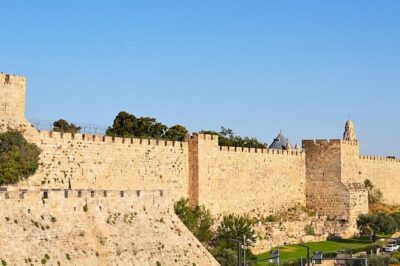
Day Tour to Jerusalem and Bethlehem from Tel Aviv
Read our review →
Browse the lists this tour appears in